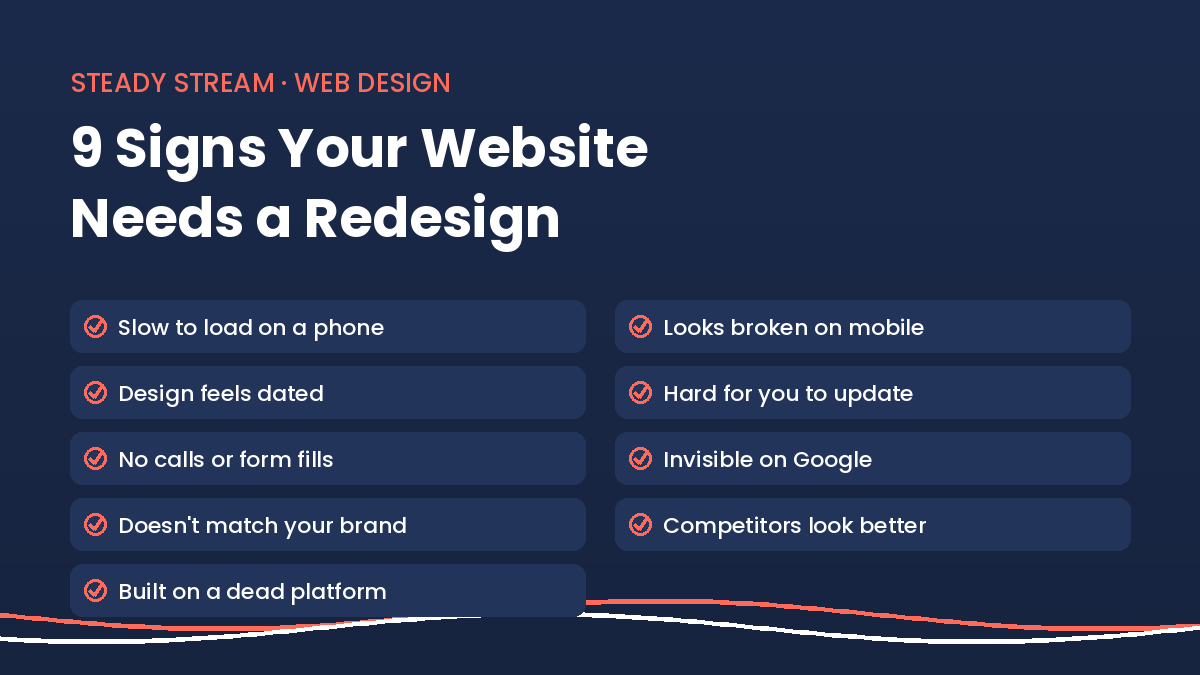
TL;DR: A small business website needs a redesign when it actively works against you: it loads slowly on phones, looks broken or dated, can’t be updated, produces no calls or enquiries, or has quietly disappeared from Google. Below are the nine signs we see most often — and the honest answer on which ones justify a rebuild versus a cheaper fix.
Most owners don’t wake up one day and decide their website is a problem. It erodes slowly — a browser update here, a competitor’s new site there — until the site that felt fine in 2021 is quietly turning people away in 2026. The tricky part is that you rarely see it happen: visitors who bounce off a slow or dated site don’t email you to explain why. They just call someone else.
Here’s the checklist we run when a business owner asks us, “is my website actually hurting me?”
How Do You Know Your Website Needs a Redesign?
1. It’s slow on a phone
More than half of local searches happen on a mobile connection, and slow pages bleed visitors fast — studies consistently show a large share of people abandon a page that takes more than about three seconds to load. Test it yourself: open your site on your phone using cellular data, not your office Wi-Fi. If you’re watching a spinner, so are your customers.
2. It looks broken or cramped on mobile
Different from slow: the site loads, but text is tiny, buttons overlap, photos spill off the edge, or you have to pinch-zoom to read anything. Google indexes the mobile version of your site first, so a desktop-only design isn’t just an inconvenience — it’s what Google judges you on.
3. The design feels five years out of date
Design trends aren’t vanity. Visitors form an impression of a website in a fraction of a second, and that impression transfers directly to your business: a dated site reads as a business that’s behind. You don’t need anything flashy — you need clean, current, and confident.
4. You can’t update it yourself (or nobody can)
If changing your hours, prices, or photos means emailing a developer who may or may not reply, your site will always be out of date. Stale content is its own red flag for both customers and Google.
5. It isn’t producing calls, forms, or bookings
This is the sign that matters most. A website is not a brochure that exists to exist — it should make the phone ring. If you honestly can’t remember the last time someone said “I found you through your website,” the site has a conversion problem: no clear phone number, no obvious next step, no reason to trust you over the next result.
6. You’re invisible on Google
Search your main service plus your town — not your business name. If you’re nowhere in the results, your site probably has structural problems: no individual service pages, thin text, missing basics. We wrote a full diagnostic on this in why your business doesn’t show up on Google.
7. It doesn’t match the business you’ve become
Businesses evolve — new services, new prices, a nicer truck, a bigger team. If your site still shows the version of your business from the day you launched it, every visitor is meeting a smaller, older company than the one they’d actually hire.
8. Your competitors’ sites are simply better
Search your service like a customer would and click your top three competitors. If their sites are faster, clearer, and more professional than yours, that’s the comparison every potential customer is making — usually with your site open in the next tab.
9. It’s built on a platform nobody maintains
Sites built on abandoned page builders, ancient WordPress themes, or a defunct freelancer’s custom code accumulate risk: security holes, plugins that can’t update, and one day a PHP upgrade that takes the whole thing down. If nobody can confidently answer “who maintains this?”, that’s your answer.
Does a Redesign Mean Starting Over From Scratch?
Not always — and an honest designer will tell you which side of the line you’re on. As a rule of thumb:
- A refresh is enough when the bones are good: the site is reasonably fast and mobile-friendly, and it mostly needs updated photos, copy, and a lighter coat of paint.
- A rebuild is worth it when the problems are structural — slow platform, broken mobile layout, no way to edit, or a codebase nobody understands. Patching a structurally bad site usually costs more over two years than rebuilding it once.
How Much Does a Redesign Cost?
Less than most owners fear, and the range is wide — from DIY-builder money to five-figure agency retainers — depending on who builds it and how much custom work is involved. We broke down the real numbers in our guide to what a small business website costs in 2026. The short version: a professionally designed small-business site typically costs a few hundred to a few thousand dollars, and a redesign is often cheaper than the original build because your content, branding, and domain already exist.
Where Should You Start?
Three things, in order, all free:
- Test your site on your phone over cellular data, like a real customer. Note everything that’s slow, cramped, or confusing.
- Search your service + your town and see where you actually stand against the businesses you compete with.
- Count last month’s website leads — calls, forms, bookings you can trace to the site. If the number is roughly zero, the site isn’t paying its rent.
If two or more of the nine signs above hit home, it’s worth a conversation. Book a free 15-minute call and we’ll give you an honest read on whether you need a refresh, a rebuild, or nothing at all — and you can browse the sites we’ve designed to see the standard we’d bring to yours. More on how we work at Steady Stream.
Website Redesign FAQ
How often should a small business redesign its website?
Every three to five years is a reasonable rhythm, but the calendar matters less than the symptoms. If your site is fast, mobile-friendly, easy to update, and producing calls, leave it alone. If two or three of the nine signs in this article apply, the date on the design is beside the point — it is costing you customers now.
Will a redesign hurt my Google rankings?
Not if it is done carefully. Rankings suffer when a redesign changes page addresses without redirects, deletes pages Google was ranking, or launches a slower site. A competent redesign keeps or redirects every existing URL, preserves the content that ranks, and usually improves speed and mobile experience — which tends to help rankings rather than hurt them.
How long does a website redesign take?
A typical agency timeline is four to eight weeks. At Steady Stream we work from your existing content and branding, so most small-business redesigns go from first call to live site in about a week. The longest delays are almost always waiting on photos, copy approvals, and login details — have those ready and everything moves faster.
Can I keep my domain name and existing content?
Yes — your domain belongs to you and moves with you, and any content worth keeping (service descriptions, photos, reviews, blog posts) should be carried over. A redesign replaces the design and the plumbing, not your identity. Be wary of any provider who wants to register the domain in their own name.