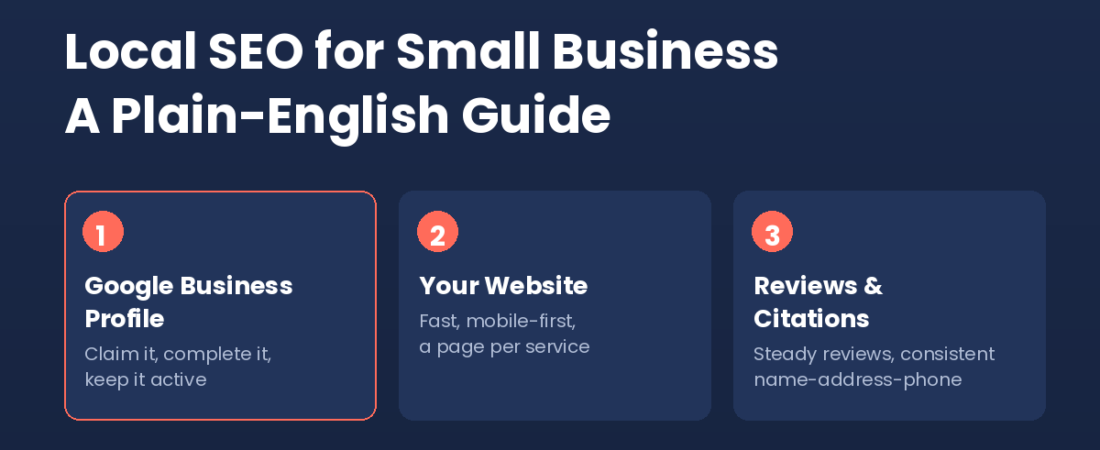
TL;DR: Local SEO is everything you do so that Google shows your business to people nearby who are searching for what you sell. It rests on three pillars: a complete, active Google Business Profile; a fast, mobile-first website with a page for each service; and steady reviews plus consistent business details across the web. None of it requires tricks — just the fundamentals, done thoroughly, for months rather than days.
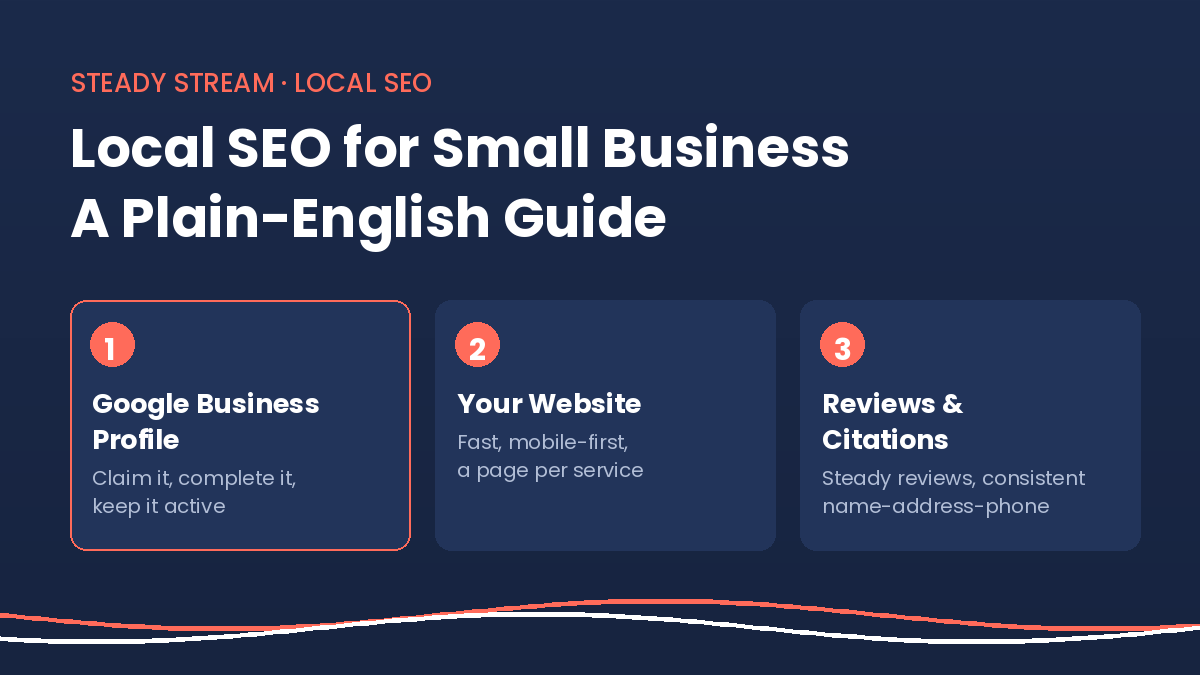
What Is Local SEO, Exactly?
When someone searches “plumber near me” or “best bakery in Dorchester,” Google doesn’t return the same results it would show someone in Seattle. It runs a separate, location-aware ranking system and shows two things: the map pack (the map with three business listings under it) and the regular organic results below. Local SEO is the work of earning a spot in both.
It is not the same as paid ads. Ads buy the labelled slots at the very top and stop the moment you stop paying. Local SEO compounds: the work you do this month keeps producing visibility next year.
How Does Google Decide Which Businesses to Show?
Google has publicly described its three local ranking factors, and they’re worth knowing by name:
- Relevance — how well your profile and website match what was searched. A “landscaping” search won’t surface a business whose pages never clearly say it does landscaping.
- Distance — how close you are to the searcher. You can’t change your address, but you can be relevant for the whole area you genuinely serve.
- Prominence — how well-known and well-regarded you appear: reviews, mentions across the web, and the general strength of your online presence.
Every tactic in local SEO is really just feeding one of those three. That’s the whole game — which is why the rest of this guide is only three pillars.
Pillar 1: Your Google Business Profile
The single highest-leverage hour a local business can spend online is completing its Google Business Profile. Claim it, verify it, and then fill in everything: exact services, hours, service area, photos of real work (not stock), and your website link. Then keep it alive — post occasionally, add new photos, answer the Q&A, and reply to reviews. Google visibly favors profiles that look actively managed, and customers do too.
Two details owners often miss: pick the correct business categories (the primary category is one of the strongest signals in the map results), and use your real business name — stuffing extra keywords into the name field violates Google’s rules and gets profiles suspended, which costs far more than it ever gains.
Pillar 2: Your Website
Your website is what turns visibility into a customer — and it feeds rankings in its own right. The local-SEO essentials are unglamorous:
- Fast and mobile-first. Most local searches happen on phones, and Google evaluates your mobile site, not your desktop site.
- A page per service. One page that says “we do roofing, siding, and gutters” ranks for none of them. A clear, genuinely informative page for each service gives Google something to match against each search.
- Your name, area, and phone number everywhere it matters — visible on the page, not buried in an image, with a tap-to-call link.
- Proof. Real photos, real reviews, specifics about your work. Pages that read like they could belong to any business anywhere rank like it.
If your site is slow, dated, or thin, this pillar caps everything else — a great profile pointing at a weak site leaks trust at exactly the wrong moment. (Wondering if yours qualifies? See our checklist of signs your website needs a redesign.)
Pillar 3: Reviews, Citations, and Consistency
Prominence is mostly earned off your own site. Three habits cover it:
- Ask for reviews, every time. A steady trickle of recent reviews beats a burst of fifty from two years ago. Make it easy — text customers your review link the day the job wraps.
- Reply to reviews — including the bad ones, briefly and professionally. Future customers read your replies as closely as the reviews.
- Keep your name, address, and phone identical everywhere — Google, Yelp, Facebook, directories, your own footer. Mismatched details quietly undermine Google’s confidence in your listing.
One caution on citations: you don’t need hundreds, and paying monthly for bulk directory submissions is rarely worth it. A couple of dozen accurate, relevant listings — the major platforms plus whatever matters in your industry and your city — does the corroborating work. After that, the marginal directory adds almost nothing.
How Long Does Local SEO Take to Work?
Honest answer: expect meaningful movement in three to six months, not days. Profile fixes can show results within weeks because they’re immediate signals; website and review momentum build more slowly and then compound. Anyone promising page one in a fortnight is either targeting searches nobody makes or planning shortcuts that get sites penalized. Slow and durable beats fast and fragile.
Can You Do Local SEO Yourself?
Genuinely, yes — most of pillar one and pillar three is diligence, not expertise, and a motivated owner can handle it in a few hours a month. The website pillar is where most owners hit the wall, because speed, structure, and design are build-quality problems rather than habit problems.
If your business doesn’t show up at all today, start with our step-by-step diagnostic: why your business doesn’t show up on Google. And if the website itself is the weak pillar, that’s exactly what we build — fast, mobile-first sites wired for local search from day one. See what Steady Stream does, browse real examples, or book a free 15-minute call and we’ll tell you honestly which pillar needs work first.
Local SEO FAQ
Is local SEO free?
The core of it, yes. A Google Business Profile costs nothing, writing service pages costs time rather than money, and asking customers for reviews is free. What you pay for — either in your own hours or a professional’s — is doing those things thoroughly and consistently. There is no required ad spend; local SEO is the alternative to renting attention through ads.
Do I need a website if I have a Google Business Profile?
Yes, if you want to compete seriously. Your profile can appear in the map results on its own, but Google cross-references it against a website to judge legitimacy and relevance, and profiles that link to a solid site tend to perform better. The website is also where you win the regular organic results — which a profile alone can never do.
What are citations in local SEO?
Citations are mentions of your business name, address, and phone number on other websites — directories like Yelp, the Better Business Bureau, industry listings, and local sites. Google uses them as corroborating evidence that your business is real and located where you say. The key is consistency: the details should match everywhere, character for character.
Does blogging actually help a local business rank?
It can, when the posts answer questions your customers genuinely search — costs, comparisons, how-tos, seasonal problems. Each useful post is another page Google can rank and another proof of expertise. Generic posts written for the sake of posting do very little; a handful of genuinely helpful articles beats a hundred filler posts.