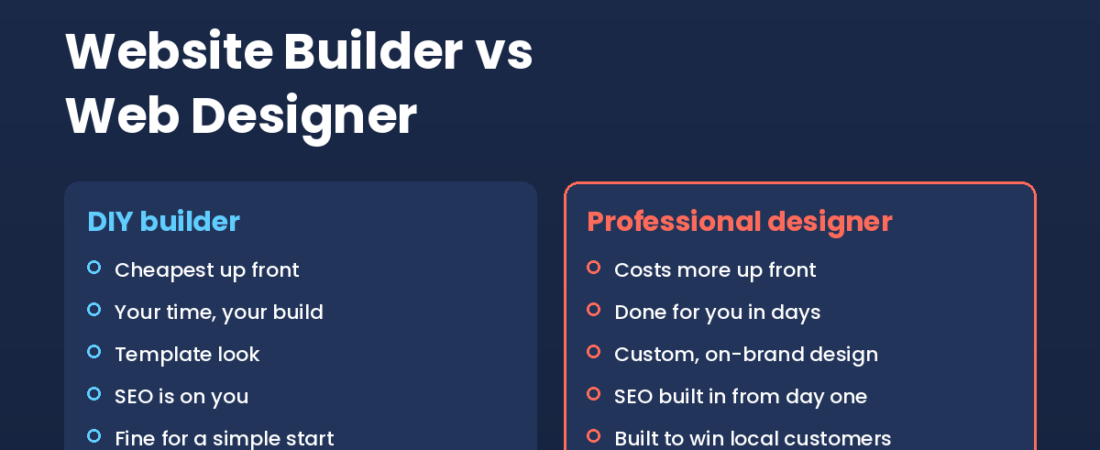
TL;DR: A DIY website builder (Wix, Squarespace, GoDaddy) is the right call when budget is near zero, your needs are simple, and your customers already know you. A professional web designer pays off when the website has a job to do — ranking on Google, winning trust from strangers, and turning visits into calls. The real comparison isn’t the sticker price; it’s your hours, the result, and what a mediocre site quietly costs you in lost customers.
What’s the Real Difference Between a Builder and a Designer?
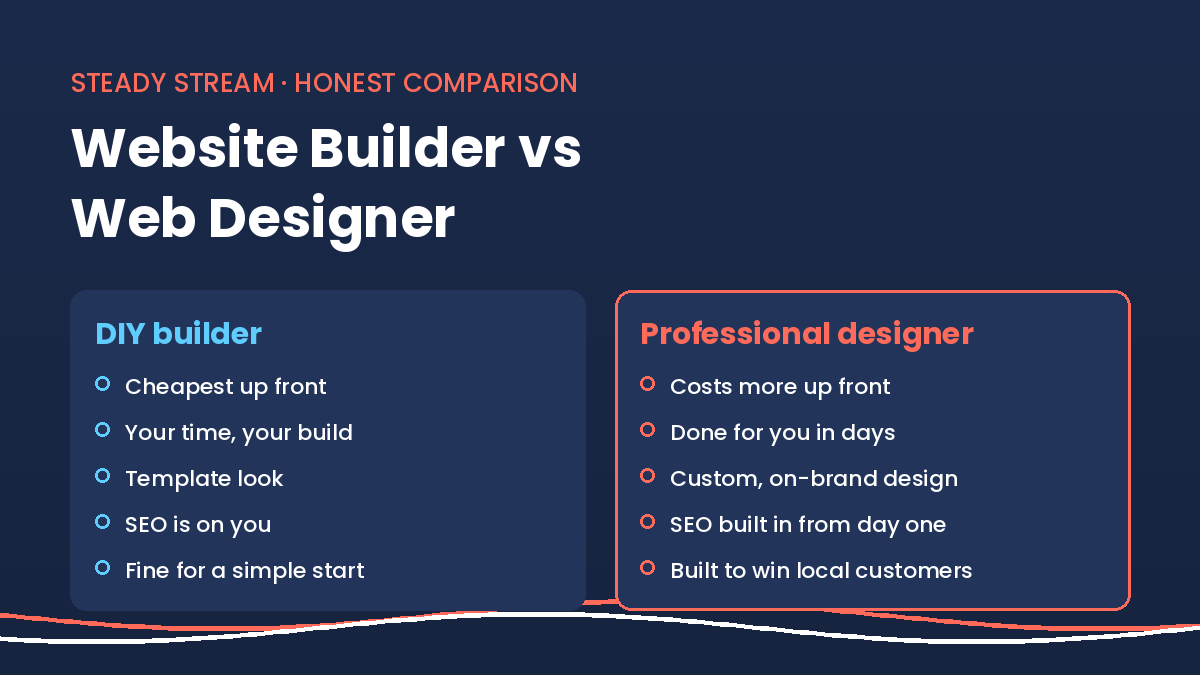
A website builder sells you tools: templates, drag-and-drop editing, and hosting bundled into a monthly fee. Everything else — the design decisions, the words, the structure, the SEO, the hours — is yours. A web designer sells you a result: a finished site, built around your business, done while you run that business.
Neither is a scam and neither is magic. The mistake is comparing them on price alone, because they aren’t selling the same thing.
When Is a DIY Website Builder the Right Call?
Honestly — sometimes it is. A builder makes sense when:
- You’re testing an idea and don’t yet know if the business will exist in a year.
- Your customers already know you — referrals and repeat work — and the site just needs to confirm you’re real.
- The budget is genuinely zero, and the choice is a builder site or no site. A builder site wins that matchup.
- You enjoy tinkering and will actually finish it. Half-built builder sites left on a “coming soon” page are more common than anyone admits.
If that’s you, take the builder route without guilt — just buy your own domain name so the site is portable later.
When Does Hiring a Web Designer Pay Off?
The equation flips when the website has to earn — which is the situation for most local service businesses:
- Strangers have to find you. Ranking for “electrician [your town]” takes proper service pages, fast load times, and clean structure — the parts of SEO that builder templates make hard and designers build in from the start.
- Strangers have to trust you. Visitors judge a site in a fraction of a second, and a recognizably-template site reads as generic. Custom design is what makes a five-person company look established.
- Your time is worth real money. The 30–60 hours a first builder site actually takes is billable time. Priced honestly, “free” DIY often costs more than hiring out.
- It has to keep working. Updates, backups, security, and someone to call when it breaks — with a maintained site that’s included; with DIY, it’s you.
Can a Builder Site Rank on Google?
Yes — nothing about Wix or Squarespace prevents ranking, and Google has said as much. But the practical gap shows up in execution: builder sites tend to ship with slower pages, one generic homepage instead of a page per service, and owners who understandably never get around to the SEO checklist. The platform allows ranking; the typical DIY build doesn’t achieve it. If local search is where your customers are, that gap is the whole ballgame — our plain-English local SEO guide shows exactly what the site needs to do.
What Are the Hidden Costs Nobody Mentions?
Both routes have costs that never appear on the pricing page, and they’re worth naming before you choose:
- The builder’s hidden cost is drift. The site goes up, life gets busy, and two years later the hours, prices, and photos are stale — because updating it always lands on you. A site that’s wrong is arguably worse than no site: it’s actively giving customers outdated information.
- The builder’s second hidden cost is the ceiling. When you eventually need something the template can’t do — online booking that fits your workflow, a page structure that ranks, a design that doesn’t look like your competitor’s — you don’t upgrade the site, you replace it. The money and hours spent perfecting the old one don’t carry over.
- The designer’s hidden cost is dependency — if you pick the wrong one. A designer who registers the domain in their own name, hosts the site somewhere you can’t access, or vanishes after launch turns your storefront into a hostage situation. The fix is simple and worth being direct about before signing anything: the domain is registered to you, you have access to the hosting, and routine text changes either come with a maintenance plan or can be done by you.
Neither list is a reason to avoid either route. It’s just the part of the comparison the pricing pages leave out.
How Do You Decide? A 60-Second Test
Answer three questions:
- Where do new customers come from? Mostly referrals → builder is fine. Mostly Google and “I found you online” → designer.
- What’s an average customer worth? If one new job covers a meaningful share of a professional build, the site only has to win you a handful of customers to pay for itself.
- Will you honestly do the work? Not “could you” — will you, this month, to a standard you’d show a customer?
Two “designer” answers out of three, and the math has made your decision. For the actual dollars involved, see our breakdown of what a small business website costs in 2026.
If you’re weighing the jump, look at the sites we’ve built — every one custom, none from a template — and book a free 15-minute call. If a builder genuinely fits your situation, we’ll tell you that too; a site that’s wrong for you doesn’t do Steady Stream any good either.
Website Builder vs Web Designer FAQ
Can I move from Wix or Squarespace to a custom site later?
Yes, and it’s one of the most common projects designers take on. Your domain moves with you, and your text and images can be carried over. What doesn’t transfer is the design itself — the new site is built fresh — so any budget you sank into perfecting the old builder layout doesn’t carry forward. Moving is routine; it’s just not free.
Is hiring a web designer worth it for a brand-new business?
It depends on how you’ll get customers. If your work comes from referrals and repeat clients, a simple builder site can be a fine placeholder. If you need strangers to find you on Google and trust you enough to call — which is most local service businesses — the site is your storefront, and the gap between adequate and good shows up directly in leads.
How much more does a professional web designer cost?
DIY builders run roughly $15–$50 a month, so $200–$600 a year, plus your hours. Professional builds span a wide range — a few hundred dollars from an independent designer to five figures from a large agency. We published real numbers in our small business website cost guide; the honest summary is that the gap is smaller than most owners assume once you price your own time.
Who owns my website when a designer builds it?
You should. The domain should be registered to you, and you should have access to the hosting and the site itself. Reputable designers set it up this way by default — it’s a fair question to ask before hiring anyone, and a red flag if the answer is vague.